

You land in Buenos Aires, you have a USD invoice to collect from a client in New York, and your landlord wants three months of rent in pesos by Friday. Your Wise account gets you partway there. Your local bank account does not exist yet. And the official exchange rate will cost you somewhere between 20 and 40 percent of whatever you move.
Or you are in São Paulo trying to pay a landlord who only accepts Pix. Your international card is useless. Every restaurant, food delivery app, and market stall in Brazil runs on Pix, and without a CPF and a Brazilian bank account, you cannot use it at all through the normal path.
Or you are in Santa Cruz de la Sierra and you have just discovered that ATMs and foreign cards give you 6.96 bolivianos per dollar while the informal rate on the street is closer to 9.05. That is roughly 30 percent of every dollar gone before you spend a single boliviano.
This is the real financial problem that LATAM-focused apps were built to solve. Wander Wallet, Takenos, Meru, and Airtm each take a different approach to it. This article breaks down how each one works, where each one falls short, and which combination of tools most nomads actually end up running in practice.
This is not a Wise vs Revolut piece. Both of those have their place, and most nomads should already have one of them. This is about the layer on top of that, the apps built specifically for the realities of living and working in Latin America.
If you do not have Wise set up yet, it is a solid baseline for receiving international transfers and converting currency at mid-market rates. But Wise alone will not solve the peso problem, the blue dollar question, or the peer-to-peer dollar transfers that make daily life in several LATAM countries actually function.
What These Apps Have in Common (And Where They Split)
All four apps in this comparison share one core feature: they give you some form of digital dollar account that sits outside the traditional banking system. That matters enormously in Argentina and Bolivia, where the gap between the official exchange rate and the parallel market rate is real and significant, and where routing your dollars through official channels costs you a substantial slice of every payment. It matters in Brazil for a different reason: not because of a rate gap, but because the entire country has shifted to Pix as its default payment method, and foreign cards simply cannot access it without a local bank account.
Where the four apps diverge is in their geographic focus, their withdrawal options, their fee structures, and the specific problems they were designed to fix. Wander Wallet and Meru lean toward the multi-country nomad. Takenos was purpose-built for Argentina's currency situation. Airtm operates more like a P2P exchange platform than a traditional neobank, which makes it the tool of last resort in restricted markets and a useful secondary option everywhere else.

Wander Wallet: Built for the Nomad Moving Between Countries
WanderWallet targets the nomad who does not stay put. It offers a USD-denominated account you can fund via international wire or ACH transfer, a debit card that works at ATMs and point-of-sale terminals across most of Latin America, and currency conversion built into the withdrawal flow.
Its core supported markets are Brazil, Argentina, and Bolivia. In Brazil you pay via Pix, in Argentina via Mercado Pago and Modo, and in Bolivia via QR Simple. These are the three payment rails that most foreign cards cannot access directly. That is the specific gap WanderWallet was built to fill.
The setup process is straightforward and does not require a local bank account or local residency documents in the country you are living in. That alone separates it from most local banking options, which can take months of paperwork to access as a foreign resident.
Brazil: Pix Without a CPF
Pix is Brazil's national instant payment system. By 2025 it was processing close to 80 billion transactions per year. Every restaurant, landlord, street market, food app, pharmacy, and most individual vendors in Brazil now accept Pix as their default payment method. Credit cards are still used, but for day-to-day life in Brazil, Pix is the infrastructure.
The problem for foreigners: Pix was built for people with a Brazilian bank account and a CPF (the Brazilian tax registration number). Getting a CPF as a tourist is possible but involves paperwork. Getting a Brazilian bank account as a non-resident is a longer process still.
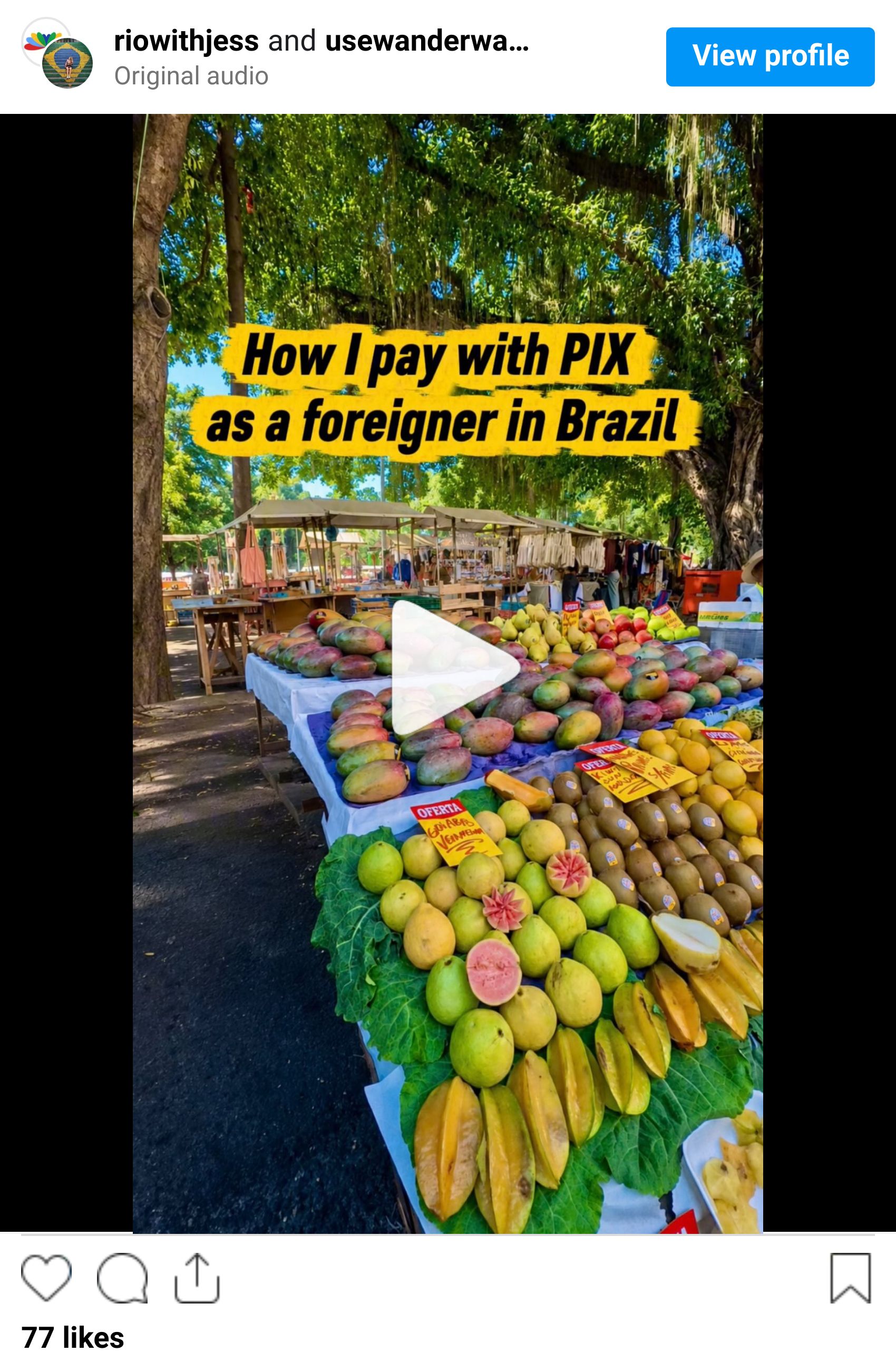
WanderWallet solves this by letting you scan any Pix QR code directly from the app. You load USD or EUR, open the scanner, point at the merchant's Pix QR code, see the BRL cost converted to your funding currency, and confirm. Payment settles instantly. No CPF required. No Brazilian bank account required. The app handles the conversion and routes the payment through Pix on your behalf.
For a long-stay nomad in Rio, São Paulo, or Florianópolis, this is not a minor convenience. It is the difference between being able to pay for rent, groceries, and daily life through the standard local system versus carrying cash everywhere or navigating workarounds. If you are spending more than a week in Brazil, download WanderWallet before you land.
Bolivia: The Parallel Rate Advantage
Bolivia has two exchange rates, and the gap between them is one of the most significant in Latin America right now. The official rate sits at 6.96 bolivianos per dollar. The parallel (blue) market rate has been running around 9.05 BOB per dollar. That is roughly 30 percent more purchasing power for every dollar you bring into the country through the right channel.
ATMs and international card payments give you the official rate. That 30 percent difference comes straight out of your budget every time you withdraw or tap your card.
WanderWallet's Bolivia rate currently runs around 8.8 BOB per dollar, which is roughly 25 percent better than what you get at an ATM. The app routes your payment through QR Simple, Bolivia's national QR payment standard, which is accepted at virtually every shop, restaurant, market, and street vendor in cities like Santa Cruz, La Paz, Cochabamba, and Sucre.
The practical result: if you are spending a month in Bolivia on a $1,500 budget and you route everything through WanderWallet instead of ATMs, the rate difference alone is worth around $375. That is a meaningful amount.
A few things worth knowing: WanderWallet's Bolivia rate floats and does not always precisely match the parallel market. Check the current rate in the app before large payments. And like any payment method that tracks an informal rate, the regulatory environment around this can shift. The approach is not illegal for the user, you are simply paying through a QR system, but it is worth understanding what you are using before you rely on it heavily.
Wander Wallet Fees at a Glance
Fee type | Amount |
|---|---|
Monthly account fee | None |
Incoming USD wire | Free |
FX conversion fee | ~1.5–2% above mid-market |
Bolivia QR rate | ~8.8 BOB/USD (vs official 6.96 — verify in-app before large payments) |
ATM withdrawal fee | $2–3 USD per withdrawal (plus ATM operator fees) |
Card spending in local currency | FX conversion fee applies |
Where WanderWallet earns its place in a nomad's stack: Brazil and Bolivia are its two strongest use cases. In Brazil, it gives you Pix access without a CPF. In Bolivia, it gives you a rate that is roughly 25 percent better than the ATM. Argentina is also supported via Mercado Pago. Where it loses ground: coverage is limited to Bolivia, Brazil, Argentina and Colombia as of mid-2026, and the conversion fee eats into large transfers.
Takenos: The Dollar Account Built Around Argentina's Reality
Takenos started as an Argentine fintech and that origin shows in what it does best. It gives you a USD account with a local virtual CBU (the Argentine banking identifier), which means you can receive transfers directly from Argentine senders without the friction of international wire routing. You can hold dollars in the account, send dollars peer-to-peer, and convert to pesos at a competitive rate that typically tracks closer to the financial dollar rate than the official one.
For nomads living in Argentina, that difference is meaningful. If you are paying rent and groceries in pesos and your income comes in USD, the rate you convert at determines how much of your purchasing power survives the transfer. Takenos has built its product around exactly that gap.
Outside Argentina, Takenos is less dominant but still useful. The USD account functions for receiving international transfers, and the peer-to-peer dollar transfer feature works across borders for users who have contacts already on the platform. It is not the strongest card for daily spending in Mexico or Brazil, but for anyone spending meaningful time in Argentina, it belongs in your wallet.
You can open a Takenos account, setup takes under 10 minutes and does not require an Argentine bank account to get started. (Affiliate disclosure: Cheers to Travels earns a commission if you open an account through this link. We only recommend tools we have researched and believe are genuinely useful.)
Takenos Fees at a Glance
Fee type | Amount |
|---|---|
Monthly account fee | None |
Incoming USD transfer | Free |
Peso conversion | Competitive rate (tracks financial dollar) |
Peer-to-peer USD transfer | Free between Takenos users |
Cash withdrawal (Argentina) | Via partner ATM network |
Meru: The Newest Option and What It Gets Right
Meru is the youngest product in this comparison and also the one with the least independent data behind it. It operates in Bolivia, Peru, Mexico, and Colombia, and its pitch is cleaner than the others: a multi-currency account designed for location-independent workers, with lower FX fees than traditional transfers and a card that works across its supported markets.
What Meru gets right is the fee structure. Its conversion rates sit closer to mid-market than most competitors, and the card has performed well for nomads in its core supported markets. What it has not yet proven is reliability at scale and country breadth. Users in Argentina and Venezuela have reported more friction than in Mexico or Colombia, and the customer support infrastructure is still catching up to the growth.
If you are based in Mexico City or Bogotá and want to reduce the cost of converting client payments to local spending money, Meru is worth testing. If you are heading into Brazil, Argentina, or into restricted markets, it is not your primary tool yet.
Meru Fees at a Glance
Fee type | Amount |
|---|---|
Monthly account fee | None |
Incoming transfer fee | Free |
FX conversion fee | ~1–1.5% above mid-market |
ATM withdrawal | Varies by market |
Card spending abroad | FX fee applies |
Airtm: The Peer-to-Peer Option for Hard-to-Reach Markets
Airtm works differently from the other three. It is not a neobank or a card-based account. It is a peer-to-peer dollar exchange platform where users buy and sell USDC (a USD-pegged stablecoin) and cash out through a network of local payment methods, including bank transfers, mobile payments, and cash pickup across more than 18 countries.
That structure makes Airtm genuinely useful in markets where other apps struggle or are unavailable: Venezuela, Cuba, and parts of Central America where standard banking infrastructure for foreigners is limited or restricted. For nomads in those markets, Airtm has been a workaround for receiving client payments and converting to usable local funds.
For nomads in Mexico, Colombia, Argentina, or Brazil, Airtm is typically a secondary tool rather than a primary one. The P2P model introduces more steps than a straight account transfer, and the fees can vary depending on which local payment method you use to cash out. It is worth having the account set up as a backup, especially if your route includes Venezuela or other restricted markets, but it is not where most LATAM nomads park their main financial workflow.
Airtm Fees at a Glance
Fee type | Amount |
|---|---|
Account fee | None |
Buying or selling USDC | Spread varies by payment method (typically 2–4%) |
Cash out via bank transfer | Varies by country and method |
Peer-to-peer transfer | Small percentage fee |
Which App Should You Use?
Most nomads who have spent real time in LATAM do not run on a single app. They run on two, with a third as a backup. Here is how that usually shakes out by situation.
If you are in Brazil: WanderWallet is the most practical tool for daily life. Pix is how Brazil operates, and WanderWallet gives you Pix access without a CPF or local bank account. Pair it with Wise for receiving international transfers in USD, then top up WanderWallet for local spending.
If you are in Bolivia: WanderWallet again. The rate via QR Simple (around 8.8 BOB/USD as of mid-2026) is roughly 25 percent better than what ATMs and foreign cards give you at the official rate of 6.96. For a month-long stay on a reasonable budget, the rate difference is worth hundreds of dollars. Check the current in-app rate before large payments, it floats.
If you are in Argentina: Takenos is the core tool for anyone navigating the peso-dollar gap. Pair it with Wise for receiving international wires and then move funds into Takenos for local spending.
If you are in Mexico or Colombia: Meru is your strongest purpose-built option here. Pair it with Wise for incoming international transfers. Both markets have reliable ATM access and card merchant acceptance.
If you are in Venezuela or another restricted market: Airtm is often the only realistic path for receiving and converting USD. Pair it with whatever local cash-out method is available and reliable in your specific city.
If you move between all of the above: A base layer of Wise plus WanderWallet for Brazil and Bolivia plus Takenos for Argentina plus Meru for Mexico and Colombia covers most of the LATAM nomad circuit. Airtm is the backup you hope you do not need.
One thing worth watching: this space moves fast. Fees change, country support expands, and a product that is thin on Argentina coverage today may look very different in six months. Check each app's current fee schedule before committing to a setup for a long stay.
For a broader look at cross-border banking for nomads, including how to structure accounts across multiple countries and what to do about tax implications, see our full guide to cross-border banking for digital nomads.
If you are planning a longer stay in Brazil specifically, the Rio de Janeiro cost of living guide for nomads breaks down exactly what you will spend month to month and which tools work best for managing money in the country.

Travel Tools
Airbnb
Good for monthly stays with strong discounts.
Booking.com
Helpful for private studios and long term deals.
Skyscanner
Simple for tracking flight prices in and out of Rio.
HolaFly
Reliable eSIM for immediate mobile data all over the world. Get 5% discount on all plans.
Amazon Travel Essentials
Useful for chargers, locks, and laptop gear.
Kiwi
Great for multi city travel across South America.
Tools to Have in Your LATAM Stack
Getting the financial setup right before a long LATAM stay saves real money. Here are the tools worth having ready before you land:
WanderWallet — The essential app for Brazil and Bolivia. In Brazil it gives you Pix access without a CPF. In Bolivia it gets you a rate roughly 25 percent better than any ATM. Free to set up, no local documents required.
Takenos — The core tool for Argentina. Holds USD, converts to pesos at a competitive rate, and receives transfers from international platforms including Wise, PayPal, and Deel. Essential for any meaningful stay in Argentina.
Meru — The best purpose-built option for Mexico and Colombia. Lower FX fees than most alternatives and a card that works cleanly in both markets.
Airtm — The backup tool for peer-to-peer USD transfers and restricted markets. Worth setting up before you need it, especially if your route includes Venezuela or Central America.
Revolut — A strong global baseline to pair with any LATAM-specific app. Use it for incoming international transfers, multi-currency spending, and as a backup card when local QR rails are not available.
SafetyWing Nomad Insurance — If you are living nomadically in LATAM, travel insurance matters more than most people plan for. SafetyWing covers you month to month with no long-term commitment. Pricing is billed in 4-week cycles starting at $62.72 per period for ages 18–39, check their site for current rates since pricing updates periodically.
FAQ
Is Takenos safe for digital nomads?
Takenos is a registered fintech operating in Argentina and has built a user base among expats and locals who need a reliable dollar account. As with any fintech app, it is best used as one tool in a multi-app stack rather than the single home for all your savings. Keep operating funds there rather than long-term reserves until you have tested it across several transactions.
How does Wander Wallet work in Latin America?
You load USD or EUR into the app, then pay by scanning local QR codes, Pix in Brazil, Mercado Pago or Modo in Argentina, and QR Simple in Bolivia. The app converts your funding currency to the local currency at the point of payment and settles instantly. No local bank account, no CPF, no residency documents required. As of mid-2026, supported markets are Brazil, Argentina, Colombia and Bolivia.
Can I use Airtm to receive USD from clients?
Yes. Airtm allows you to receive USD from clients via USDC transfer, which you then convert to local currency through the platform's peer-to-peer network. The process adds a few steps compared to a standard wire, and fees vary by cash-out method. For most mainstream LATAM markets, a direct wire into Wise or Wander Wallet is simpler. Airtm is most useful where those options are restricted.
What is the best app to withdraw cash in Argentina as an expat?
Takenos is the most commonly used tool for this among long-stay nomads in Argentina. It gives you access to a USD account with peso conversion at a competitive rate, which is the core financial challenge in Argentina. Pair it with a separate international account (Wise or Revolut) for receiving income.
Do I need a US bank account to use these apps?
No. Wander Wallet, Takenos, Meru, and Airtm all allow you to receive funds via international wire without a US bank account. Some features (like ACH transfers for Wander Wallet) work best if you have a US account, but the core functionality is accessible to nomads banking outside the US.
Does WanderWallet give you the parallel rate in Bolivia?
WanderWallet's Bolivia rate runs around 8.8 BOB per dollar as of mid-2026, compared to the official ATM rate of 6.96. That is roughly 25 percent better than the official rate, and close to (though not exactly at) the parallel market rate of around 9.05. The rate floats, so check the current figure in the app before making large payments. The payment itself goes through QR Simple, Bolivia's national QR system, which is widely accepted at merchants across major cities.
Can foreigners use Pix in Brazil without a CPF?
Yes, through WanderWallet. Standard Pix requires a Brazilian bank account and CPF (the Brazilian tax number). WanderWallet bypasses this by letting you scan any Pix QR code from the app, converting your USD or EUR to BRL and routing the payment through Pix. No CPF, no Brazilian bank account, and no local SIM card required. Payment settles instantly.
Affiliate Disclaimer: Some of the links in this post are affiliate links, which means if you purchase through them, Cheers to Travels may earn a small commission, at no extra cost to you. We only recommend products we truly believe in.


